

A ceiling stain after a hard Greenwood rain is easy to dismiss for a day or two. The spot may look dry by morning. The drip may stop when the storm passes. The room may smell normal until humidity rises again. But if water has already reached the drywall, the leak has usually traveled through shingles, underlayment, decking, insulation, or attic framing before it ever showed up inside.
For homeowners in Greenwood, roof leaks tend to show up after the exact weather that makes southside homes work hard: spring downpours, wind-driven summer storms, humid attic conditions, clogged gutters during leaf season, and freeze-thaw cycles that test flashing and pipe boots through winter. Whether you live near Old Town Greenwood, Center Grove, Worthsville Road, Smith Valley Road, County Line Road, or closer to the I-65 corridor, the right next step is the same: stop the water from spreading, document what you see, and get the roof inspected before a small leak becomes drywall, insulation, decking, or mold damage.
If your roof is leaking in Greenwood right now, call (317) 886-0696 or request a free inspection from Raptor Roofing. We inspect the roof system, attic, flashing, roof penetrations, gutters, and storm damage indicators so you know whether you need a focused roof repair, storm documentation, or a larger replacement plan.
Quick Answer: What Should You Do if Your Roof Is Leaking in Greenwood?
If water is showing up after rain, treat it as an active roof-system problem until the source is found. Protect the room, document the stain or drip, avoid climbing on a wet roof, and schedule an inspection that checks the roof, attic, flashing, pipe boots, valleys, gutters, and storm damage indicators.
- Move what matters: Pull furniture, electronics, rugs, and valuables away from the leak area.
- Control the drip safely: Use a bucket or towel only where it is safe to stand, and stay away from wet electrical fixtures.
- Take photos: Photograph ceiling stains, attic moisture, missing shingles, gutter overflow, and any storm debris.
- Do not patch blindly: Caulk, tar, or ceiling paint can hide the symptom without solving the water path.
- Get the source checked: A dry ceiling tomorrow does not mean the roof, decking, or insulation dried out.
The goal is to stop the water path before it spreads into drywall, insulation, decking, or attic framing.
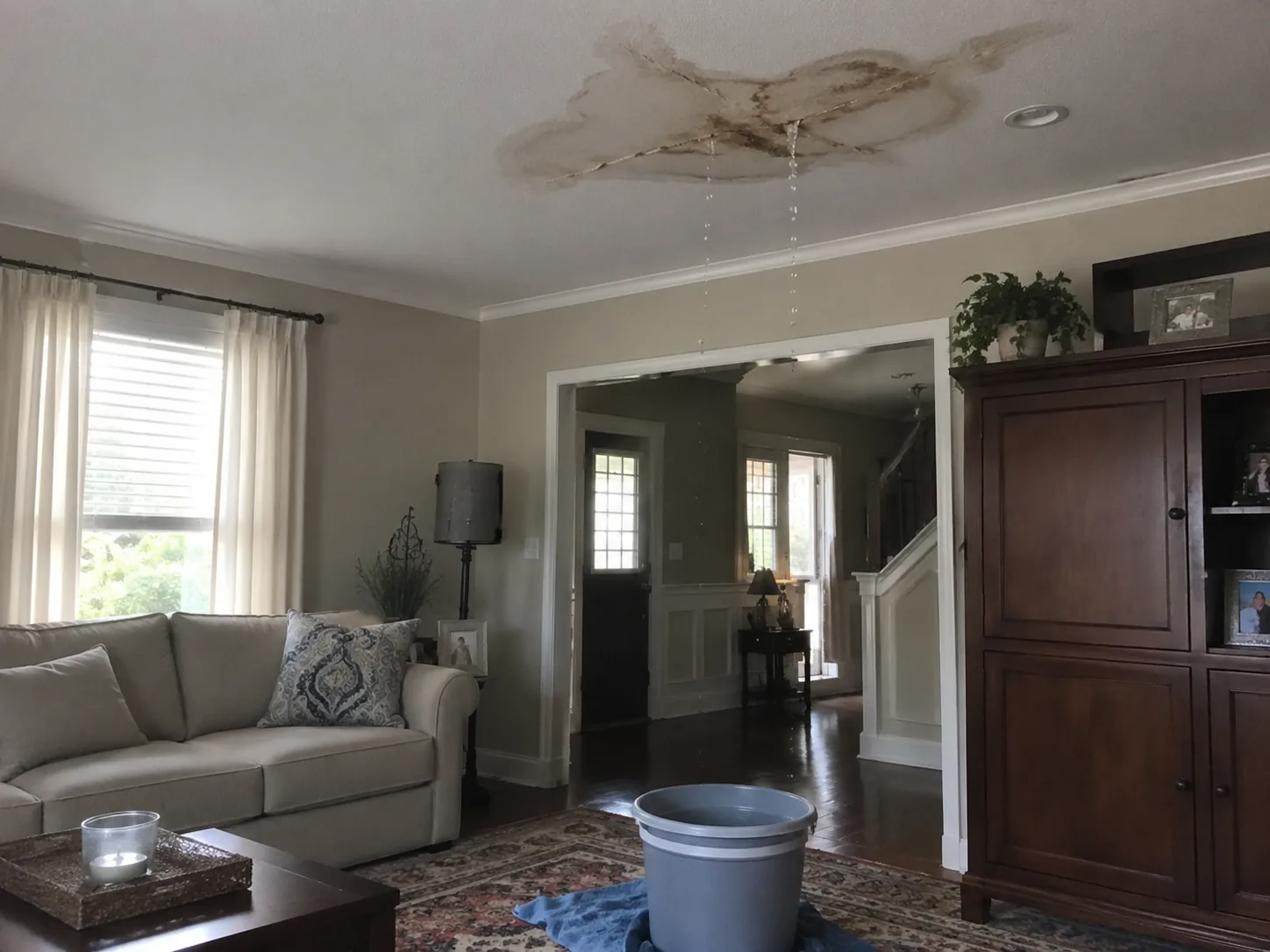
First, Protect the Room Without Climbing on the Roof
If water is actively dripping, focus on the inside of the home first. A wet roof is not the place to test your balance, especially during wind, lightning, or dark conditions. Move furniture, electronics, rugs, and personal items away from the leak. Set a bucket or plastic container under the drip. If the ceiling is bulging, keep people and pets out of the room until it can be checked safely because waterlogged drywall can release suddenly.
Take clear photos and short videos before cleaning everything up. Photograph the ceiling stain, the wall below it, the floor, any wet insulation you can see safely, and the exterior roof area from the ground if visible. These photos help a roofing contractor trace the leak and can also support an insurance conversation if storm damage is involved.
If water is near a light fixture, ceiling fan, outlet, breaker panel, or appliance, avoid touching the fixture and shut off power to that area if you can do so safely. Water and electrical components are not a wait-and-see situation. Once the room is contained, schedule a roof inspection. Paint can hide a stain, but it cannot stop the water source above it.
Why Roof Leaks Are So Common Around Greenwood
Greenwood homes sit in a busy Central Indiana weather lane. Nearby Indianapolis climate normals show more than 43 inches of precipitation in a typical year, with wetter spring and early summer months that can push roof systems quickly from “aging” to “actively leaking.” That matters because most roof leaks do not begin as a dramatic hole. They usually begin where water is forced into a weak detail over and over again.
Greenwood also has a wide mix of housing. Older homes near Old Town and Main Street may have more complicated rooflines, older decking, aging chimney flashing, additions, or previous repair work. Neighborhoods around Center Grove, Stop 18 Road, Worthsville Road, and Smith Valley Road often include larger roof planes, valleys, dormers, ridge vents, skylights, and long gutter runs that need good drainage. Homes closer to open fields and newer subdivisions can see strong wind exposure during southside storms, while mature-tree lots can deal with leaves, branches, shaded roof sections, and slower drying after rain.
The City of Greenwood also notes that development changes how rainfall runoff moves through the community, which is one reason stormwater systems matter locally. Your roof and gutters are the first drainage system your home has. When gutters clog, downspouts dump water near the foundation, valleys fill with debris, or roof edges back up during heavy rain, water can start entering places it was never meant to go.
What a Greenwood Roof Leak Usually Looks Like Inside
A roof leak can appear in several different ways. The most obvious is active dripping during heavy rain, but many Greenwood homeowners first notice a brown ring on the ceiling, peeling paint near a wall, a soft drywall seam, or a musty attic smell after storms. These symptoms deserve attention even if the roof looks normal from the yard.
- Brown or yellow ceiling stains: Often appear after repeated moisture has soaked through drywall or plaster.
- Peeling or bubbling paint: Usually means water is moving behind the surface, not just sitting on top of it.
- Musty odors upstairs: Can point to damp insulation, wet decking, or attic moisture that has not dried out.
- Drips near ceiling fixtures: Need quick attention because water may be following framing or wiring paths.
- Stains that grow after storms: Strongly suggest rain entry through the roof, flashing, vent, gutter, or wall-roof transition.
- Wet attic insulation: Often holds moisture against wood and drywall long after the rain stops.
The leak source may not be directly above the stain. Water can enter near a pipe boot, chimney, valley, ridge vent, nail pop, or lifted shingle, then travel along a rafter before dripping into insulation several feet away. That is why a real roof leak inspection is more than glancing at the ceiling and guessing.
Roof Leak or Plumbing Leak? How to Tell Where to Start
Not every ceiling stain comes from the roof. Plumbing, HVAC condensation, bathroom exhaust issues, and attic humidity can look similar at first. The timing and location of the stain usually give the first clue.
If the stain grows during or shortly after rain, especially on the top floor, under an attic, near an exterior wall, around a chimney, or below a roof valley, call a roofer first. If the stain appears below an upstairs bathroom, laundry room, water heater, or kitchen plumbing and gets worse when fixtures are used, a plumber may need to be involved. If the spot appears during humid weather near an attic HVAC unit, duct line, or bathroom fan, condensation or mechanical drainage could be part of the issue.
Many homes have overlapping causes. A roof leak can soak insulation and make attic humidity worse. Poor attic ventilation can make roof decking stay damp longer. Clogged gutters can push water under shingles and also send water down exterior walls. A professional inspection helps separate the symptom from the source.
| What you notice | Where to start | Why it matters |
|---|---|---|
| Stain grows during or after rain | Roof inspection | Often points to shingles, flashing, valleys, pipe boots, gutter overflow, or wind-driven rain entry. |
| Spot is below an upstairs bathroom or laundry | Plumbing check, then roof if rain timing matches | Fixture use, supply lines, drains, and roof penetrations can create similar-looking ceiling stains. |
| Moisture appears near an attic HVAC unit or bath fan | Condensation and ventilation review | Humidity, duct issues, and poor attic airflow can keep roof decking and insulation damp. |
| Water appears after wind or hail | Storm damage documentation | Lifted shingles, bruised shingles, damaged vents, and loose flashing may need photos before repairs begin. |
Raptor Takeaway
In Greenwood, a leak that only shows up during heavy rain can still be serious. Wind-driven rain, older flashing, clogged gutters, cracked pipe boots, and storm-lifted shingles often leak intermittently, then dry out before the damage looks dramatic.
The Most Common Roof Leak Sources We Look For
Pipe Boots and Roof Vents
Pipe boots are one of the most common leak points on asphalt shingle roofs. The rubber collar around a plumbing vent can crack from sun exposure, age, and temperature swings. Once that collar splits, rain can run straight down the pipe and into the attic. On many Greenwood homes, this shows up as a ceiling stain in a bathroom, hallway, closet, or upper bedroom even though the shingles around the pipe still look fine from the ground.
Chimney and Wall Flashing
Flashing is the metal detail that keeps water out where the roof meets a vertical surface. Chimneys, sidewalls, dormers, and step flashing are all common leak zones. Older homes near Old Town Greenwood and homes with additions may have flashing details that have been patched, painted, caulked, or layered over the years. Caulk alone is not a roof system. If the flashing is loose, corroded, poorly lapped, or separated from the masonry or siding, wind-driven rain can find its way in.
Valleys and Roof Transitions
A roof valley handles more water than a regular roof plane. When two slopes meet, rain concentrates there before draining into the gutter. Leaves, granules, branches, and winter debris can slow that flow. Homes around mature trees near Craig Park, Old Town, and established neighborhoods off Main Street or Smith Valley Road can be especially vulnerable when valley debris sits for too long.
Missing, Lifted, or Creased Shingles
After a strong storm, shingles may lift, crease, tear, or lose seal strength. Sometimes the damage is obvious from the ground. Other times the shingle settles back down and the leak only shows up when rain is pushed from the right direction. A small lifted area can let water reach nails, seams, and underlayment, especially during repeated storms.
Gutter Backups at the Roof Edge
Gutters do more than protect landscaping. They move water off the roof edge before it can soak fascia, overflow behind the gutter, or back up under the first courses of shingles. In Greenwood neighborhoods with mature trees, fall leaf buildup can turn a normal rain into a roof-edge leak. If you see water pouring over the gutter instead of through the downspout, do not assume the roof is the only problem.
Ice, Snow, and Freeze-Thaw Movement
Central Indiana winters can create freeze-thaw stress even without deep snow. Meltwater can refreeze at roof edges, in gutters, and around poorly ventilated attic spaces. When water repeatedly freezes and thaws, it can exploit tiny openings around flashing, nails, valleys, and roof edges. The stain may not appear until the next warm rain exposes the weakened detail.
Greenwood Areas Where Leak Patterns Can Be Different
A roof leak is always specific to the home, but Greenwood’s neighborhoods do create different inspection priorities.
- Old Town Greenwood and Main Street area: Older rooflines, chimneys, additions, low-slope porch roofs, and older decking can make flashing and transition details especially important.
- Center Grove and southwest Greenwood: Larger homes often have multiple valleys, steep slopes, dormers, skylights, and long gutter runs that need close drainage review.
- Worthsville Road and southeast growth areas: Newer subdivisions may still face wind exposure, installation detail issues, builder-grade ventilation concerns, and storm-related shingle lifting.
- Smith Valley Road, Stop 18 Road, and County Line Road corridors: Mixed roof ages and tree coverage can make gutter backups, roof debris, and aging pipe boots common inspection points.
- Homes near Pleasant Creek, Grassy Creek, and lower drainage areas: Roof leaks are separate from ground flooding, but heavy rain patterns often reveal both drainage and roof-system weaknesses at the same time.
That level of local detail matters because a generic “roof repair near me” answer often misses the real cause. A roof may need a pipe boot replacement, new step flashing, a valley repair, gutter correction, storm documentation, ventilation improvement, or full replacement depending on age and damage spread.
What Raptor Checks During a Greenwood Roof Leak Inspection
A leak inspection should connect the inside symptom to the outside source. Raptor Roofing starts with the homeowner’s observations: when the stain appeared, whether it grows during rain, what room it is in, whether the attic is accessible, and whether recent wind or hail moved through the area. Then we inspect the roof system and supporting details.
- Ceiling stain location and likely water travel path
- Attic moisture, wet insulation, darkened decking, and nail penetrations
- Pipe boots, roof vents, ridge vents, bathroom exhaust vents, and other penetrations
- Chimney flashing, wall flashing, dormers, skylights, and roof-to-wall transitions
- Valleys, starter rows, eaves, rake edges, and vulnerable shingle courses
- Missing, lifted, creased, cracked, or hail-impacted shingles
- Gutter flow, downspout discharge, roof-edge staining, and debris buildup
- Roof age, prior repair work, ventilation, and replacement risk factors
After the inspection, you should understand what was found, what can be repaired, what should be monitored, and what would make replacement the smarter long-term decision. A good leak inspection should not feel like a mystery or a sales pitch. It should give you a clear path.
When a Roof Leak Can Usually Be Repaired
A focused repair may make sense when the roof is still in good condition and the leak comes from one identifiable failure point. Examples include a cracked pipe boot, a small section of failed flashing, a few missing shingles, a localized valley issue, or a gutter-related roof-edge problem. In those cases, repairing the right detail can stop the leak without replacing the entire roof.
Repair-first thinking is especially helpful when the roof has usable life left, the shingles are still sealing properly, and there is no widespread storm damage. The key is accuracy. A cheap patch that misses the source costs more if the stain comes back during the next storm.
When Replacement Becomes the Better Answer
Replacement becomes more likely when leaks are recurring, the roof is near the end of its service life, shingles are brittle or losing granules, decking is soft, storm damage appears across multiple slopes, or previous repairs have stacked up without solving the problem. A roof can reach the point where one repair only buys a little time before the next weak detail fails.
For many Greenwood homeowners, the decision comes down to risk. If the roof is older and the leak has already reached insulation or drywall, it may be worth comparing the cost of another repair against the cost of a roof system that resets the home’s protection. Raptor can walk you through both options without making the decision feel bigger than it needs to be.
What About Storm Damage and Insurance?
If the leak followed wind, hail, falling branches, or a severe storm, document everything before repairs begin. Take photos of interior water damage, exterior debris, visible shingles, gutters, and any damaged personal property. Do not throw away damaged materials until you know whether documentation is needed.
Insurance coverage depends on your policy and the cause of the damage. Sudden storm damage is different from long-term wear, old flashing, or deferred maintenance. Raptor Roofing can provide photos and inspection notes so you understand what appears storm-related and what appears age-related. That clarity helps you decide whether to start a claim conversation with your carrier.
How Much Does Roof Leak Repair Cost in Greenwood?
The cost depends on the source of the leak, roof pitch, material type, access, damage spread, and whether interior materials were affected. A small pipe boot or shingle repair is a very different project from replacing rotted decking, rebuilding flashing, correcting valley drainage, and handling drywall or insulation damage. The longer water travels unnoticed, the more expensive the repair tends to become.
That is why a free inspection matters. You do not need a blind quote. You need to know whether the leak is isolated, whether the roof is storm damaged, whether the attic is wet, and whether the repair will actually solve the problem. Once the source is identified, Raptor can give you clear next steps and options.
How to Reduce Future Leak Risk
- Have the roof inspected after major wind, hail, or heavy rain events.
- Keep gutters and downspouts clear, especially during fall leaf season.
- Watch ceilings and attic spaces after the first heavy rain following winter.
- Do not ignore small stains that appear dry; mark the edge with a pencil and check whether it grows.
- Look from the ground for missing shingles, lifted edges, damaged flashing, and gutter overflow.
- Keep tree branches trimmed away from the roof where possible.
- Make sure bathroom fans vent outside, not into the attic.
- Ask about attic ventilation if you notice musty odors, condensation, or recurring moisture.
Preventing roof leaks is not about climbing on the roof every month. It is about paying attention to the details that move water safely off the house: shingles, flashing, valleys, gutters, ventilation, and roof penetrations.
Schedule a Greenwood Roof Leak Inspection
If you are seeing a ceiling stain, attic moisture, dripping water, missing shingles, or storm damage in Greenwood, do not wait for the next rain to test the roof again. Raptor Roofing serves homeowners across Greenwood, Center Grove, Old Town, Worthsville Road, Smith Valley Road, County Line Road, and surrounding Johnson County communities.
Get the Leak Source Checked Before the Next Rain
Raptor Roofing helps Greenwood homeowners find the source, understand the repair options, document storm-related concerns when needed, and protect the home before the leak spreads.
If the ceiling stain, attic moisture, or drip came after rain, start with a free roof inspection.
Frequently Asked Questions About Leaking Roofs in Greenwood
Is a ceiling stain always a roof leak?
No. Ceiling stains can come from roof leaks, plumbing leaks, HVAC condensation, attic humidity, or bathroom exhaust problems. If the stain appears or grows after rain, especially on the top floor or near an exterior wall, start with a roof inspection.
Can Raptor inspect my roof if the leak stopped?
Yes. Many roof leaks stop when the rain stops, but the path may still be visible through stained decking, damp insulation, cracked pipe boots, failed flashing, lifted shingles, or storm damage. A dry day is often safer and better for inspecting the roof.
Should I climb into the attic during a leak?
Only if you can do so safely. Do not step on drywall, touch wet electrical components, or move through an attic during lightning or active storm conditions. Photos from a safe attic access point can help, but your safety matters more than the picture.
Can a small roof leak cause mold?
Yes. Moisture trapped in insulation, drywall, or wood can create mold risk over time. Even a small leak should be addressed quickly because the visible stain may be only a small part of the moisture path.
Do I need roof repair or roof replacement?
It depends on the roof age, leak source, shingle condition, decking condition, storm damage, and whether the leak is isolated or recurring. Raptor will inspect the roof and explain whether a focused repair is enough or whether replacement is the more reliable option.
Do you provide emergency roof leak help in Greenwood?
Call to describe the concern and confirm current availability. Timing and temporary protection depend on weather, safe access, roof condition, and crew capacity.